Home / Guides / Form 5472 line by line for a foreign-owned single-member LLC
Taxes · Updated 2026-11-28

The short version
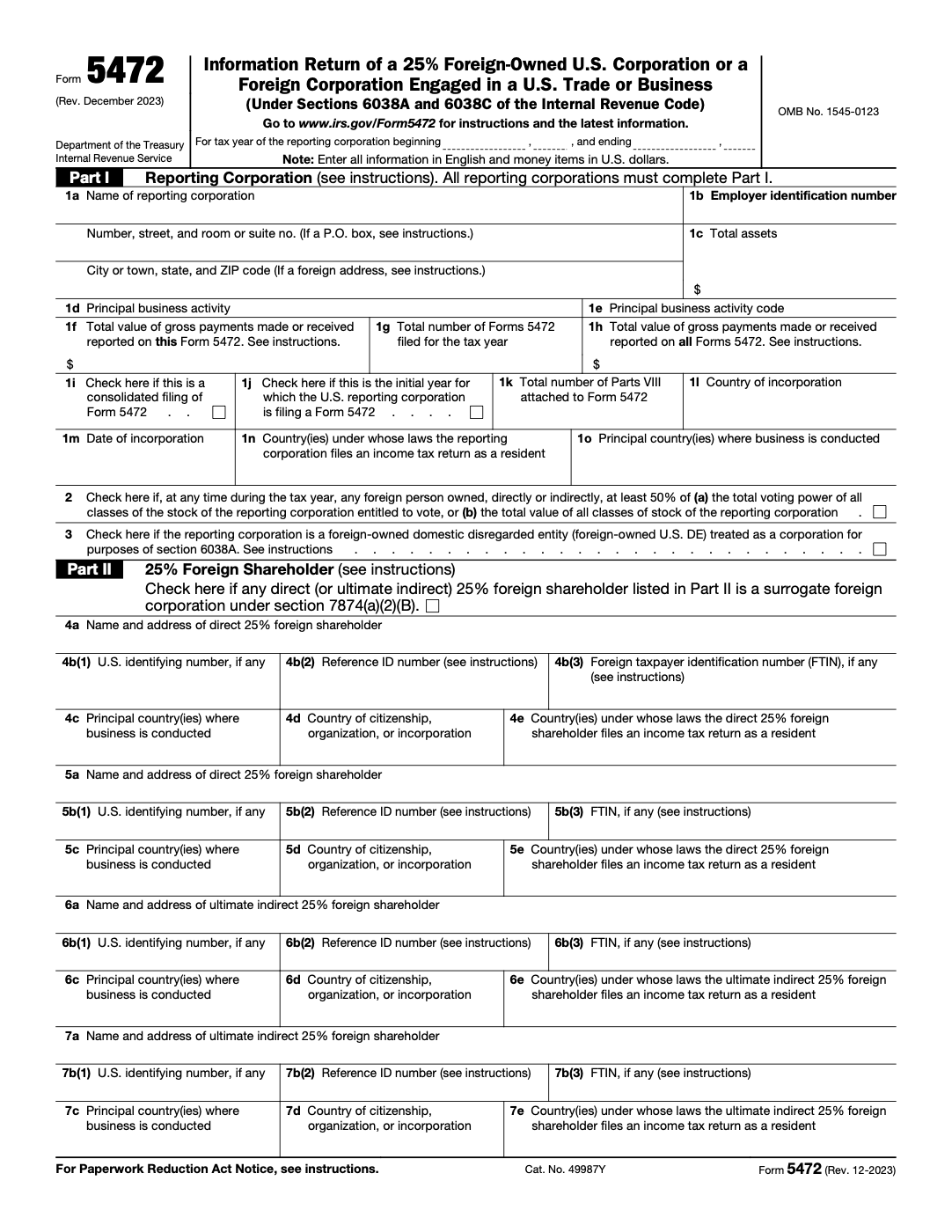
A single-member LLC owned by a foreign person is, for this one purpose, treated by the IRS as a corporation that is separate from its owner. The IRS calls it a "foreign-owned U.S. DE" (disregarded entity). If it had a reportable transaction with its owner or another related party, it files Form 5472, attached to a nearly empty pro forma Form 1120, by fax or mail. It cannot e-file. This guide goes through the IRS instructions in the order you would fill the form, and every rule below is taken from the IRS Instructions for Form 5472 as published on IRS.gov and checked on 28 November 2026.
Who the IRS means
- Reporting corporation: "a 25% foreign-owned U.S. corporation (including a foreign-owned U.S. disregarded entity (DE))" or a foreign corporation engaged in a U.S. trade or business.
- Foreign-owned U.S. DE: a domestic DE that is wholly owned by a foreign person. For tax years beginning on or after 1 January 2017 and ending on or after 13 December 2017, it is treated as an entity separate from its owner, classified as a corporation, for the limited purposes of section 6038A.
- Foreign person: among others, an individual who is not a citizen or resident of the United States, or a partnership, company or corporation not organized in the United States.
- Related party: any direct or indirect 25% foreign shareholder of the reporting corporation, and certain people related to it or to that shareholder. For a single-member LLC, the foreign owner is a related party.
Do you have to file?
The IRS says a reporting corporation generally must file "if it had a reportable transaction with a foreign or domestic related party." It does not have to file if it had no reportable transactions of the types listed in Parts IV and VI of the form and, for a foreign-owned U.S. DE, none of the type listed in Part V either. Several other exceptions on the IRS list do not apply to foreign-owned DEs.
That makes the question one of transactions, not of income. The next section shows why a company with no revenue can still have something to report.
What counts as a reportable transaction
| Part IV | Monetary transactions with a foreign related party, where money was the only consideration, of the types listed on the form such as sales and rents. "Do not complete Part IV for transactions with a domestic related party." Paid and received include accrued amounts. |
|---|---|
| Part V (foreign-owned DEs only) | "You must check the box in Part V if you are a foreign-owned DE that had any other transaction" not already entered in Part IV. The instructions say these include "amounts paid or received in connection with the formation, dissolution, acquisition, and disposition of the entity, including contributions to, and distributions from, the entity." Describe them on an attached statement. |
| Part VI | Nonmonetary and less-than-full-consideration transactions with a foreign related party. Attach a schedule describing each transaction or group, with enough information to see its nature and approximate monetary value. |
Part V is the reason a dormant LLC may still file. If the foreign owner put money into the company, or took money out, the instructions list contributions and distributions among the transactions to report. Whether your particular facts fit is a question for a professional who prepares these filings.
The pro forma Form 1120
A foreign-owned U.S. DE has no income tax return filing requirement of its own. Because of the section 6038A regulations, it must file a pro forma Form 1120 with Form 5472 attached. The IRS says "the only information required to be completed on Form 1120 is the name and address of the foreign-owned U.S. DE and items B and E on the first page." Write "Foreign-owned U.S. DE" across the top of the Form 1120. The tax year is the one the owner uses for U.S. filing, or the calendar year if the owner has none.
Part I: the reporting company
| Line 1a, address | Include the suite, room or unit number. For a foreign address, enter city, province or state, then country, and do not abbreviate the country name. |
|---|---|
| Line 1c, total assets | The instruction for domestic reporting corporations points to Form 1120, page 1, item D. The pro forma return asks only for items B and E, so ask your preparer how a DE completes this line. |
| Lines 1d and 1e | Describe the principal business activity and enter the activity code from the Form 1120 instructions. |
| Line 1f | The total value in U.S. dollars of foreign related party transactions in Parts IV and VI, and for a foreign-owned U.S. DE, Part V. Do not complete it for a transaction with a U.S. related party. |
| Line 1g | "File a separate Form 5472 for each foreign or U.S. person who is a related party with which the reporting corporation had a reportable transaction." Enter the total number of Forms 5472 you are filing, including this one. |
| Line 1h | The total of line 1f across all Forms 5472 filed for the tax year. |
| Line 1j | Check the box if this is the first year the company has filed Form 5472. |
| Line 1o | List the principal countries where business is conducted. Do not write "worldwide." |
| Line 3 | "Check this box if you are a foreign-owned U.S. DE." |
Part II: the foreign owner
The IRS says: "For a foreign-owned U.S. DE, report the information for the foreign owner on the lines provided for the 25% foreign shareholder." The form has room for two direct and two ultimate indirect shareholders; use an attached sheet for more. An individual enters an SSN or ITIN if issued, and other entities enter an EIN. A reference ID number is needed only when no U.S. identifying number was entered. The instructions also tell you to list the principal countries where the shareholder does business on the matching lines.
Parts IV, V and VI in practice
- Separate forms: one Form 5472 per related party you had a reportable transaction with.
- Currency: state amounts in U.S. dollars and attach a schedule showing the exchange rates used.
- Small amounts: if the actual amount of a transaction or series with a foreign related party does not exceed a total of $50,000, it may be reported as "$50,000 or less."
- Estimates: when actual amounts cannot be determined, a reasonable estimate is "at least 75% but not more than 125% of the actual amount."
- Accrual accounting: an entity on the accrual method uses accrued payments and receipts.
Where, how and when to file
- You cannot e-file. The IRS says a foreign-owned U.S. DE "cannot file Form 5472 electronically."
- Fax (300 DPI or higher): 855-887-7737. Mail: Internal Revenue Service, 1973 Rulon White Blvd, M/S 6112, Attn: PIN Unit, Ogden, UT 84201. DEs do not use the mailing address in the regular Form 1120 instructions.
- When: by the due date, including extensions, of the pro forma Form 1120. The Form 1120 instructions say a corporation generally files by the 15th day of the 4th month after its tax year ends, which is 15 April for a calendar-year company.
- Extension: file Form 7004 by the regular due date. Put the Form 1120 code on Part I, line 1, write "Foreign-owned U.S. DE" across the top, and fax or mail it to the same number or address. The Form 7004 instructions say the automatic extension is generally 6 months.
Penalties and records
- $25,000 for failing to file Form 5472 "when due and in the manner prescribed." The IRS adds that filing a substantially incomplete form counts as a failure to file.
- If the failure continues for more than 90 days after IRS notification, an additional $25,000 applies for each 30-day period, or part of one, after the 90 days end, for each related party for which a failure occurs.
- The penalty also applies for failure to keep records required by Regulations section 1.6038A-3, and the instructions say criminal penalties under sections 7203, 7206 and 7207 may also apply to failure to submit information or to false or fraudulent information.
- Keep permanent books or records sufficient to establish the correctness of the return, including information relevant to transactions with related parties.
A hypothetical walk-through
Illustration only. The numbers are invented, and it is not advice. A single-member LLC is owned by a nonresident individual. During the year the owner sent $3,000 to the company's bank account to pay state fees and a registered agent, and the company earned no revenue. The company is a foreign-owned U.S. DE, so line 3 is checked. The owner is reported in Part II. The $3,000 is a contribution to the entity, which the instructions list among the Part V transactions, so the Part V box is checked and a statement describing it is attached. One Form 5472 is filed because there is one related party, so line 1g is 1. The pro forma Form 1120 carries the company's name and address and items B and E, with "Foreign-owned U.S. DE" across the top, and both go by fax or mail by the due date. Whether another amount, such as a loan from the owner or a payment to the owner, belongs in Part IV or V depends on its character, so a preparer should review it.
Points the instructions make that people miss
- No income does not by itself mean no filing. Contributions and distributions are named in Part V.
- Electronic filing is not available to a foreign-owned DE.
- The Form 1120 and Form 7004 use the dedicated Ogden address and fax, not the regular ones.
- An incomplete Form 5472 is treated as not filed.
- One form per related party, not one per company.
Sources to check
- IRS Instructions for Form 5472 (definitions, who must file, when and where, Parts I to VII, penalties, records)
- Form 5472
- IRS Instructions for Form 1120 (when to file)
- IRS Instructions for Form 7004 (automatic extension)
Not legal or tax advice. This guide explains general rules. Check the cited sources for current requirements, and confirm tax positions with a licensed CPA or EA.